7 Best AI Platforms for Research Surveys 2026

The integration of Artificial Intelligence into brand research has shifted the landscape from static, weeks-long study cycles to dynamic, real-time insight generation. Modernconsumer research platforms now leverage Large Language Models (LLMs) and machine learning to automate complex tasks such as survey design, open-ended text coding, and predictive audience modeling.
For CPG professionals and brand leaders, this means the ability to validate concepts, track brand health, and optimize product experiences with unprecedented speed and granular accuracy.
AI brand research platforms at a glance
|
Platform |
Industry Focus |
AI Capabilities |
User Experience |
CPG Features |
|
Highlight |
In-Home Usage Testing (IHUT) |
Automated logistics & quality control |
High engagement through physical products |
Physical product testing, concept validation |
|
Standard Insights |
End-to-end Consumer Research |
AI-generated surveys & automated visuals |
User-friendly with AI accelerators |
Rapid concept testing |
|
Qualtrics |
Enterprise Experience Management |
Predictive intelligence & text analysis |
Comprehensive but complex interface |
Brand health tracking, CX optimization |
|
Displayr |
Analysis & Visualization |
AI text coding & automated reporting |
Intuitive for analysts, steep learning curve for beginners |
Survey data analysis, dashboard creation |
|
Quantilope |
Automated Advanced Methods |
Automated Conjoint & MaxDiff |
Fast setup with real-time dashboards |
Pricing research, product feature prioritization |
|
Inca |
Conversational Surveys |
SmartProbe chatbot logic |
Engaging conversational UI |
Deep dive qualitative research |
|
Stravito |
Insights Management |
Generative AI search assistant |
Seamless search in enterprise environments |
Enterprise knowledge management |
|
Brandwatch |
Consumer Intelligence and Social Listening |
NLP brand reputation scoring, Iris AI query assistant |
Powerful but enterprise-grade complexity |
Brand health tracking, competitive intelligence, trend monitoring |
|
Pollfish |
DIY Survey Research |
AI survey generation, fraud detection |
Fast and self-serve with CPG-specific templates |
Brand awareness and perception tracking, concept testing |
Highlight
Platform summary
Highlight is a product research platform that enables product teams to infuse their entire product lifecycle with consumer insights. Highlight’s agile in-home usage testing (IHUT) platform streamlines the logistical complexities of physical product research. By merging a robust digitalresearch surveys interface with a physical distribution network, the platform allows CPG brands (and beyond) to send products directly to verified consumers' homes. This ensures that the data collected reflects real-world usage and sensory experiences rather than hypothetical responses gathered in a vacuum.
The platform is specifically designed to close the transparency gap in traditional home testing. Insights professionals can monitor shipping status, trigger surveys the moment a package is opened, and collect high-fidelityproduct insights and quantitative data in one centralized platform, including both real-time results and automated analytics like Crosstabs, Scorecards, and Penalty Analysis. This vertical integration reduces the need for multiple vendors and significantly shortens the timeline for product validation,sensory testing, and other forms of consumer testing.
Key benefits
- End-to-end automation of sample logistics and consumer recruitment
- Real-time, high-fidelity feedback from verified users
- Seamless integration of physical and digital research workflows
- Higher completion rates and richer qualitative data than traditional panels
Core features
- Automated logistics and recruitment: Handles targeting and shipping of samples to ensure research is conducted with verified users.
- Agile survey dashboard: Surveys are triggered by product delivery, capturing feedback at the moment of experience.
- Highlight AI: Engaging interface and verified usage drive deeper qualitative insights powered by intelligence.
- Centralized analytics: Cross-tabulate demographic and product performance data in real time.
Primary use cases
- Physical product testing in real consumer environments
- Concept testing with niche audiences before full-scale launch
- Competitive testing and benchmarking
- Sensory research (taste, texture, scent) at scale
Recent updates
- Enhanced dashboard analytics for faster demographic cross-tabulation
- Implementation of new features for expanded recruitment capabilities
- Improved targeting for niche and specialty product research
Limitations
- Physical product testing dependent on physical shipping timelines
- Higher project costs for highly targeted or complex sample distributions
- Higher costs for dedicated customer success manager
Standard Insights
Platform summary
Standard Insights is a comprehensive consumer research platform built to democratize access to high-quality quantitative data through heavy AI automation. It is designed to assist brand marketers and researchers in accelerating every stage of the study lifecycle, from initial questionnaire drafting to final data visualization. The platform focuses on removing the manual “grind” of research, allowing teams to focus on strategy rather than data entry.
Core features
- AI survey generation for rapid, methodologically sound questionnaire creation
- Automated data visualization with instant interactive charts
- AI-driven audience sampling and feasibility checks
Primary use cases
- End-to-end consumer research (from survey creation to dashboard)
- Rapid concept and message testing
- DIY market analysis for non-researchers
Recent updates
- Advanced AI reporting for share-ready dashboards
- Fraud detection for respondent quality assurance
Limitations
- Survey-centric (not a generic form or CRM tool)
- Limited integrations with external BI/CRM systems
- Advanced modeling requires data export to specialized tools
Qualtrics
Platform summary
Qualtrics is an enterprise-level Experience Management (XM) platform that uses sophisticated AI to analyze the intersections of brand, customer, and employee experiences. It is built to handle massive volumes of data, processing billions of conversation records to provide predictive intelligence and deep sentiment analysis.
Core features
- Predictive intelligence for proactive strategy
- Text iQ for advanced NLP and sentiment analysis
- Cross-channel feedback collection
Primary use cases
- Brand health tracking at global scale
- Customer experience (CX) journey optimization
- Employee engagement and internal sentiment analysis
Recent updates
- Deeper AI integration for employee attrition prediction
- Expanded sentiment analysis database (3.5B+ conversations annually)
Limitations
- High cost, opaque pricing
- Steep learning curve and complex implementation
- Not suited for quick, ad-hoc research needs
Displayr
Platform summary
Displayr is a specialized analysis and reporting platform designed to modernize the traditional research workflow by replacing the combination of SPSS and PowerPoint. It uses AI to automate the most time-consuming aspects of data processing, such as cleaning, weighting, and coding open-ended responses.
Core features
- AI text analytics for instant qualitative coding
- Automated, dynamic reporting dashboards
- Full suite of statistical tools (no coding required)
Primary use cases
- Efficient survey data cleaning and analysis
- Interactive dashboard creation for stakeholders
- Longitudinal tracking studies
Recent updates
- Natural language interface for research assistant-style analysis
- Enhanced data cleaning and enrichment via AI prompts
Limitations
- Not a data collection tool (requires external survey data)
- Learning curve for advanced features and R integration
- Browser performance can lag with massive datasets
Quantilope
Platform summary
Quantilope is an automated consumer research platform that prioritizes speed and advanced quantitative methodology. It automates complex research methods—such as Conjoint Analysis and MaxDiff—making high-end quantitative studies accessible in days, not weeks.
Core features
- Automated Conjoint and MaxDiff analysis
- AI Co-Pilot for insight summaries and data interpretation
- Real-time dashboards for instant field monitoring
Primary use cases
- Pricing research and willingness-to-pay studies
- Product feature prioritization
- Continuous brand health tracking
Recent updates
- Automated survey creation tools
- Enhanced AI Co-Pilot for faster, more actionable insights
Limitations
- Premium pricing (may be out of reach for smaller brands)
- Less flexibility for highly bespoke research designs
- Focused on quantitative methods (not ideal for pure qualitative studies)
Inca (Nexxt Intelligence)
Platform summary
Inca reimagines the traditional survey by transforming it into a conversational experience driven by an AI chatbot. It engages Highlighters in a dialogue that mimics a qualitative interview, eliciting richer, more nuanced feedback while maintaining the scale and speed of a quantitative survey.
Core features
- SmartProbe API for automated, context-aware follow-up questions
- Conversational, mobile-first survey UI
- AI coding for instant theme and sentiment tagging
Primary use cases
- Deep dive qualitative research at scale
- Engaging hard-to-reach or younger demographics
- Hybrid qual-quant studies
Recent updates
- More empathetic and contextually relevant SmartProbe follow-ups
- Expanded language support (90+ languages)
Limitations
- Not suitable for all question types (e.g., complex grids)
- Pricing requires a demo (not transparent)
- Analysis of conversational data can be more complex
Stravito
Platform summary
Stravito is an AI-powered knowledge management platform designed to centralize and synthesize market research for large organizations. It acts as an internal search engine for proprietary insights, making past research easily discoverable and actionable.
Core features
- Stravito Assistant for generative AI Q&A
- Multimodal search (text, charts, images)
- Source-linked citations for data trust
Primary use cases
- Enterprise knowledge management and research centralization
- Desk research and rapid topic exploration
- Breaking down departmental silos
Recent updates
- Deep generative AI integration for conversational search
- Enhanced security and compliance for proprietary data
Limitations
- Only as good as the research you upload (no new data collection)
- Significant initial effort to centralize content
-
Targeted at large enterprises (may be too robust for small teams)
Brandwatch
Platform summary
Brandwatch is an enterprise consumer intelligence platform built for brand leaders who need to understand what consumers are saying at scale and in real time. Rather than designing surveys and waiting for responses, Brandwatch taps into more than 100 million online sources, including social media, news sites, blogs, forums, and review platforms, to surface organic consumer conversations as they happen. For CPG brands managing reputation across multiple markets and product lines, this passive listening approach captures sentiment that structured surveys often miss: the unfiltered, unprompted voice of consumers at the point of reaction.
Core features
- AI-powered real-time brand reputation ratings across harm, spam, and emotion dimensions
- Generative AI assistant for query creation and research acceleration
- Audience segmentation and demographic analysis of brand conversation participants
- Social Listening: Cross-channel monitoring of brand mentions, competitor activity, and category trends
Primary use cases
- Brand reputation monitoring and crisis management
- Competitive intelligence and share-of-voice tracking
- Consumer trend identification across social and digital channels
Recent updates
- React Score launch for AI-powered brand threat detection (2024)
- Iris AI query assistant rollout for generative AI-supported research (Q1 2025)
- Google Cloud partnership to integrate Vertex AI and Gemini models into analytics
Limitations
- Focuses on organic social and web data — not a primary research or survey tool
- Custom pricing with no publicly available rate card; typically positioned at enterprise budgets
- Does not manage physical product logistics or conduct primary quantitative research
- Interface complexity can be steep for teams without dedicated social intelligence staff
Pollfish
Platform summary
Pollfish is a DIY market research platform designed for teams that need fast, reliable consumer data without the overhead of a traditional panel provider. Powered by Prodege—one of the world's largest consumer insights companies with a first-party panel network—Pollfish combines AI-assisted survey creation with direct access to verified audiences in a single platform. Pollfish offers pre-built templates including Brand Awareness, Brand Diagnostic, Brand Perception, and a dedicated CPG Brand Awareness and Perceptions template, all designed by research experts with built-in bias controls and branching logic.
Core features
- Generates professional survey questionnaires from a single descriptive sentence
- Templates for Brand Awareness, Brand Perception, Brand Diagnostic, and CPG Brand Awareness and Perceptions
- Built-in data analysis and visualization tool for cross-tabs and dashboards
- Device fingerprinting, behavioral quality checks, and human review of open-text responses
Primary use cases
- Brand awareness and perception tracking for CPG brands
- Concept and message testing with fast turnaround
- Competitive benchmarking and share-of-mind measurement
Recent updates
- Pollfish AI launch for AI-powered survey questionnaire generation
- Insights Builder integration for in-platform data visualization and reporting
- Expanded first-party panel coverage through Prodege network growth
Limitations
- DIY-first model may require research expertise for complex study designs
- Less suited for qualitative or conversational research methods
- Advanced managed services available but at additional cost
- Niche audience targeting can extend turnaround times beyond the standard few hours
What are AI platforms for brand research surveys?
AI platforms for brand research surveys represent a significant evolution from traditional online survey tools. These advanced systems leverage artificial intelligence and machine learning to automate and enhance every stage of the research process, from survey design and audience recruitment to data analysis and insight generation. Instead of simply collecting answers, these platforms can intelligently design survey flows, use natural language processing (NLP) to analyze open-ended text responses for sentiment and key themes, and identify complex patterns in quantitative data that a human analyst might miss. This transforms the survey from a static questionnaire into a dynamic, intelligent data-gathering engine.
Why are they important for CPG brands?
In the hyper-competitive CPG landscape, speed and depth of insight are critical competitive advantages. AI-powered survey platforms are important because they drastically accelerate the "time-to-insight," enabling brand leaders and R&D scientists to get actionable consumer feedback in days, not weeks. This speed allows brands to react quickly to market shifts, test new product concepts, and optimize marketing campaigns in near real-time. Furthermore, the depth of analysis provided by AI uncovers the "why" behind consumer behavior, extracting nuanced emotions and unmet needs from qualitative data at a scale previously impossible. This allows CPG pros to build a more authentic, data-driven understanding of their target audience, leading to more successful product innovations and stronger brand equity.
How to choose the best solution provider
Choosing the right AI survey platform requires looking beyond marketing claims and evaluating the technology's practical application for your CPG brand. First, assess the sophistication of the AI itself—does it offer advanced NLP for nuanced thematic and sentiment analysis of open-ended feedback, or just basic keyword counting? Second, scrutinize the quality and targeting capabilities of theiraudience insights tool.
The platform must be able to reliably access your specific consumer segments, whether they are parents of young children, pet owners, or followers of a specific diet. Finally, evaluate the platform's usability and integration capabilities. A powerful tool is useless if your team finds it difficult to use. Look for an intuitive interface, customizable reporting dashboards, and the ability to integrate with your existing data ecosystems to ensure the insights can be easily shared and actioned across your organization.
What are the main benefits of using AI-powered platforms for brand research surveys?
AI-powered platforms dramatically reduce the time and manual effort required to conduct brand research. They automate tasks like survey creation, respondent targeting, data cleaning, and analysis, enabling CPG Consumer Insights pros to generate actionable insights in real time. These platforms also improve data quality through advanced fraud detection, predictive analytics, and richer qualitative feedback, making it easier to validate concepts, track brand health, and optimize product experiences with greater accuracy and speed.
How do AI brand research platforms ensure data quality and respondent authenticity?
Most leading AI research platforms incorporate multiple layers of quality assurance. This includes automated fraud detection to identify and remove low-quality or duplicate responses, AI-driven audience sampling to ensure demographic accuracy, and real-time monitoring of survey engagement. Platforms like Highlight verify users through physical product delivery, while others use digital fingerprinting and behavioral analytics to confirm respondent authenticity.
Which AI platform is best for physical product testing and in-home usage studies?
Highlight specializes in in-home usage testing (IHUT) and physical product research. It manages the end-to-end logistics of sending products to verified consumers, triggering surveys upon delivery, and collecting high-fidelity feedback in real-world settings. This makes it ideal for CPG brands looking to validate sensory attributes (taste, texture, scent) and prototype performance before a full-scale launch.
Highlight’s platform also enables research along the full product lifecycle, making digital-only options like concept testing quick and easy.
Can these AI platforms handle both quantitative and qualitative research needs?
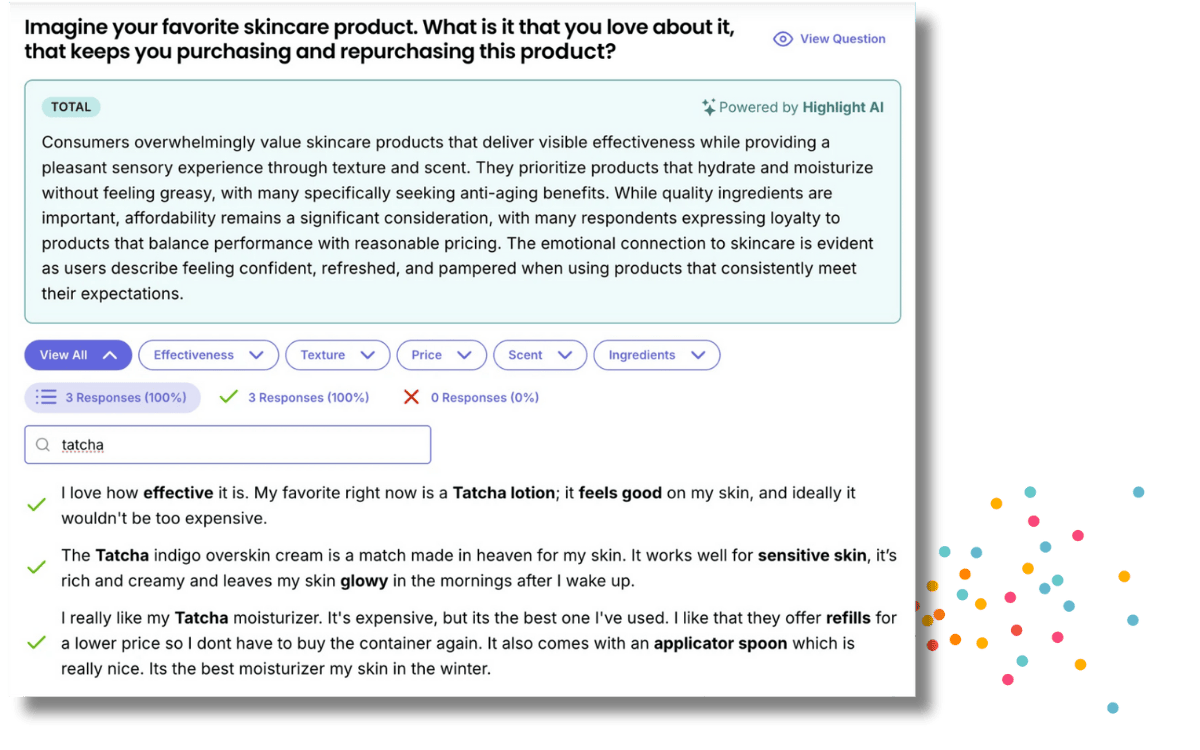
Yes, many platforms now offer hybrid capabilities. For example, Inca uses conversational AI to collect rich qualitative insights at scale, while platforms like Qualtrics and Displayr combine advanced quantitative analytics with AI-powered text and sentiment analysis. However, some tools are more specialized—Quantilope excels in quantitative methods like Conjoint and MaxDiff, while Inca is optimized for qualitative, dialogue-based research. Likewise Highlight powers research-grade survey design incorporating both quantitative and qualitative questions, and uses “Highlight AI” to enable faster qualitative analysis with open-ended response summaries, surfacing oft-repeated keywords, and incorporating a search bar for deeper analysis of your responses.
What factors should CPG Consumer Insights Pros consider when choosing an AI brand research platform?
Key considerations include the type of research needed (quantitative vs. qualitative), industry focus (e.g., CPG, apparel, food), integration with existing workflows, scalability, cost, and ease of use. For physical product testing, platforms like Highlight are optimal. For advanced analytics and enterprise-scale research, Qualtrics or Displayr may be more suitable. Teams should also evaluate the platform’s AI capabilities, respondent quality controls, and support for niche or hard-to-reach audiences.
Related reading: Using AI for market research · Compare the Top Consumer Research Platforms for Product Testing · Top market research companies for CPG product teams.